

You save the photo. Send it to your interior designer. And say:
“I want something like this.”
But choosing your renovation materials based on how they photograph is one thing. Living with them every day is another.
What you see is only the tip of the iceberg. How well each material performs over time depends on its individual maintenance required and of course, your living habits too.
So before choosing a material because it looks good on your Pinterest board, here are six trending renovation materials worth understanding, including what they cost, how they are maintained and what they are really like to live with.
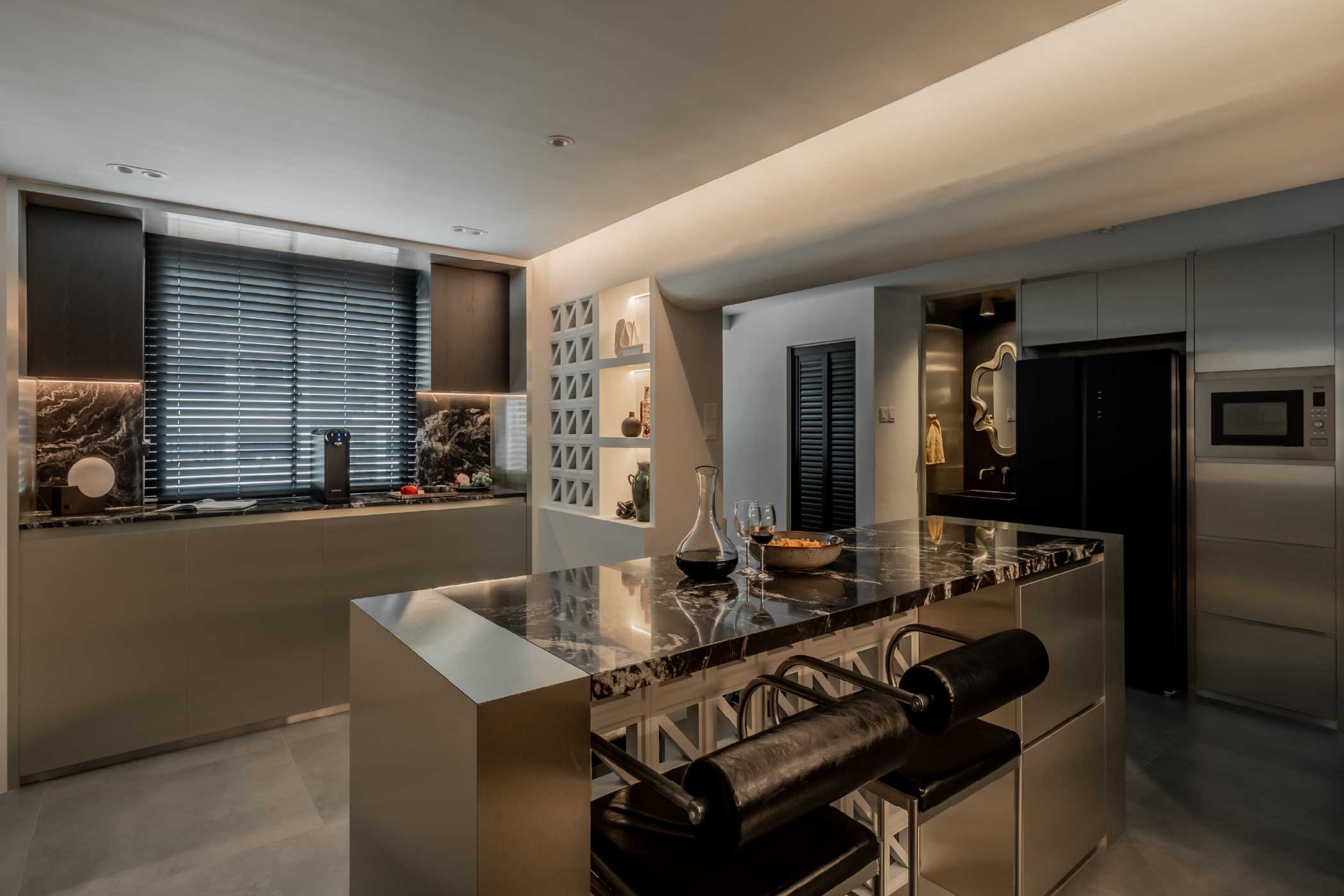
Image Credits: Saege (Project Diary- Featuring Terence Cao's Home)
1. Metallic Surfaces: Sleek, Industrial and Not Always What They Seem
Metallic surfaces have long been associated with commercial kitchens, hospitals and industrial environments. Today, that once-utilitarian aesthetic is increasingly finding its way into residential interiors.
In our Project Diary featuring Terence Cao’s recently renovated childhood home, metallic finishes were used alongside darker tones, raw textures and retro details to create an industrial-inspired interior.
One finish in particular caught people's attention.
What many assumed was stainless steel was Formica's Aluminium Longline, a genuine metal laminate available in brushed and anodised aluminium finishes. It brought the cool, reflective quality of metal into the carpentry without using stainless steel throughout.
And that is worth distinguishing when looking at renovation inspiration: a surface can give you the stainless-steel look without being stainless steel.
Why homeowners like it
Metallic surfaces bring a cooler, more industrial edge into the home. Depending on the finish, they can introduce:
-
A sleek, reflective quality
-
Texture and visual depth
-
An industrial-inspired character
-
Contrast against warmer materials such as wood
-
A more unexpected finish for carpentry and feature surfaces
If it is primarily the metallic look you are after, rather than the performance of a stainless-steel worktop, aluminium or other metal finishes can also be explored across cabinetry, feature walls and vertical surfaces.
The reality
Not every metallic surface you see in a renovation is stainless steel. Metal laminates, aluminium finishes and other surface treatments can create a similar cool, metallic appearance, but they may perform differently when it comes to heat, scratches, moisture and everyday wear.
That means homeowners should look beyond the finish and ask what the actual material is, especially when choosing it for kitchens or other frequently used areas.
For some, signs of use can become part of the lived-in character. For others, every new mark may stand out.
What is it like to maintain?
This depends on the actual surface.
Stainless steel, aluminium laminates and other metallic finishes may look similar, but their cleaning and maintenance requirements can differ.
Before deciding on one, ask your interior designer or supplier:
-
What is the actual surface material?
-
Does it show fingerprints or water marks easily?
-
How resistant is it to scratches?
-
Can it be used near heat or wet areas?
-
What cleaning products should be avoided?
With metallic surfaces, knowing what you are actually choosing matters just as much as how it looks.
Estimated Cost
Approximately S$250–S$400 per linear foot for a basic custom countertop, with more complex fabrication of integrated sinks costing more.
Key Takeaways
Pros: Adds a sleek, reflective quality and a distinctive industrial edge.
Consider: Different metallic surfaces can have very different performance and maintenance requirements.
Best for: Homeowners who want a stronger industrial or contemporary character and are comfortable with a finish that may show signs of everyday use.
Works well with: Industrial, contemporary, modern minimalist and retro-inspired interiors.
Before choosing: Find out whether the surface is stainless steel, aluminium, a metal laminate or another metallic finish, as this will affect how it performs and how it should be maintained.
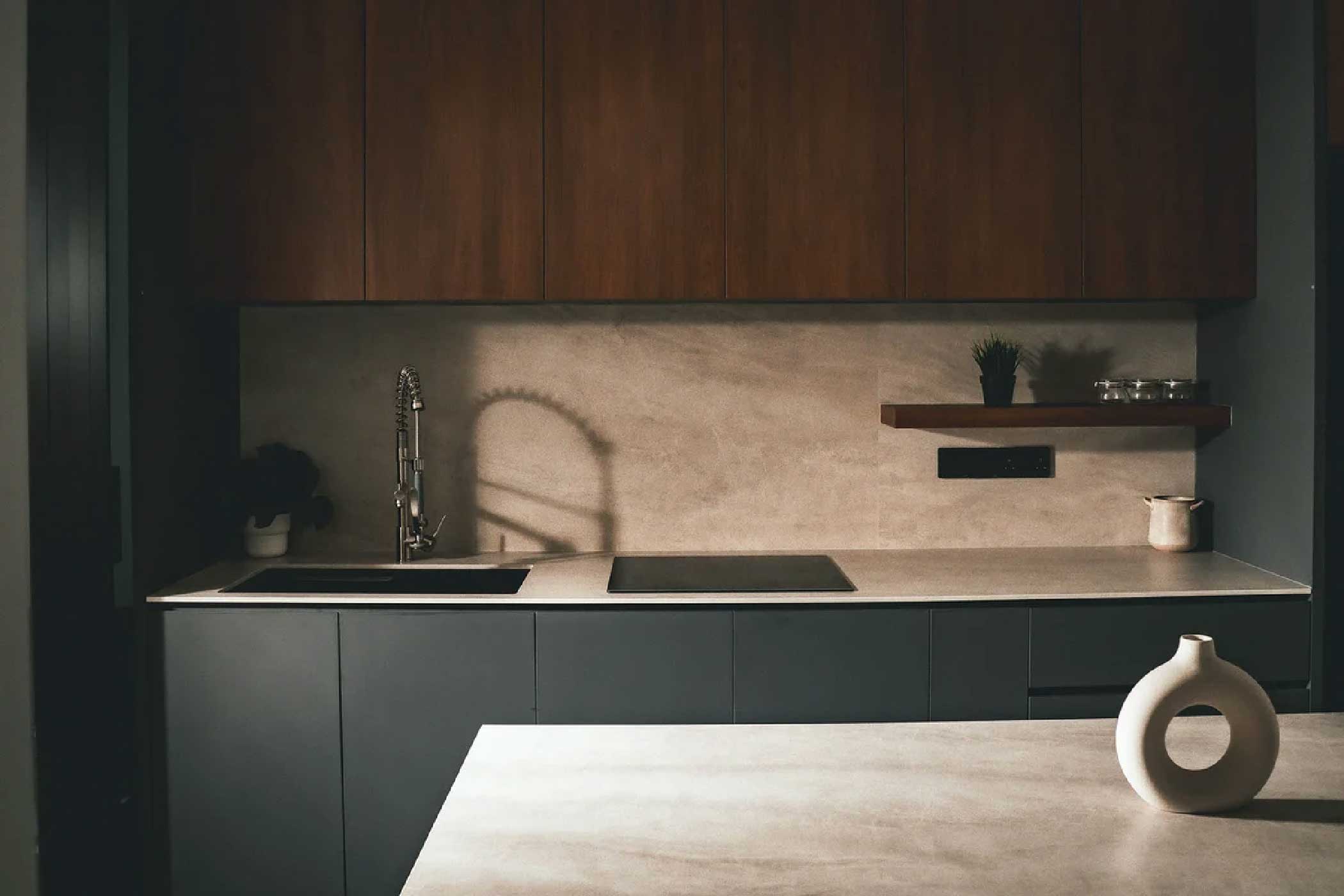
Image Credits: Elysian Design Studio
2. Sintered Stone: The High-Performance Countertop
Unlike marble and granite, which have been used in architecture for centuries, sintered stone belongs to a much newer generation of engineered surfaces.
Modern ultra-compact surfaces gained traction in the 2010s as manufacturers developed ways of subjecting mineral-based materials to intense heat and pressure to create extremely dense slabs.
Today, sintered stone sits alongside quartz, granite and marble as one of the countertop options commonly considered by Singapore homeowners.
Why homeowners like it
Sintered stone is valued for:
-
Strong resistance to heat
-
High resistance to stains
-
Good scratch resistance
-
Very low porosity
-
A wide range of colours and stone-inspired finishes
It can recreate anything from understated solid colours to dramatic marble-style veining.
The reality
However, durability does not mean indestructible.
Potential weak points include:
-
Exposed corners
-
Thin edges
-
Sink cut-outs
-
Areas subjected to heavy impact
Fabrication matters too. A premium slab with poorly finished edges or cut-outs can undermine the durability you paid for.
What is it like to maintain?
For sintered stone, day-to-day upkeep is relatively straightforward.
Generally:
-
Water and mild detergent are sufficient
-
Spills are less likely to penetrate due to its low porosity
-
Periodic sealing is typically less of a concern than with some natural stones
-
Grease and food residue should still be cleaned promptly
Estimated Cost
Roughly S$120–S$220 per foot run, depending on brand, thickness, edge detailing and fabrication.
Key Takeaways
Pros: Strong resistance to heat, stains and scratches with relatively low maintenance.
Consider: Premium pricing and potential chipping around vulnerable edges.
Best for: Families and frequent cooks looking for a relatively fuss-free countertop.
Works well with: Modern luxe, contemporary, minimalist and hotel-inspired interiors.
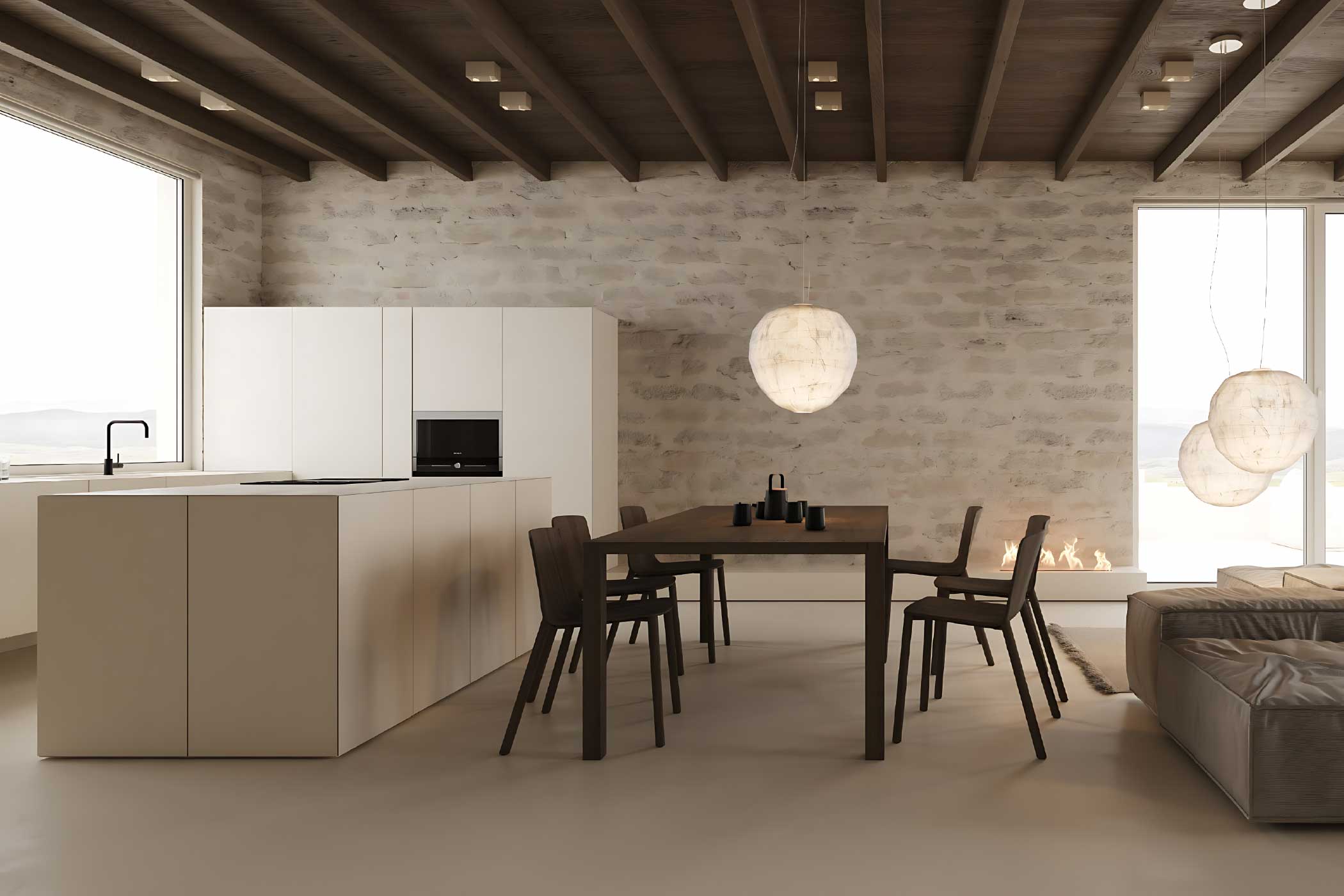
3. Microcement: From Industrial Coating to Designer Finish
Microcement did not begin as the Pinterest-friendly finish we recognise today.
Modern microcement evolved from thin cement-based and polymer-modified coatings developed to protect and finish concrete. By the late 20th century, advances in polymers allowed these coatings to become thinner, more flexible and suitable for decorative applications.
Today, microcement has moved firmly into residential interiors.
Why homeowners like it
-
Fewer visual interruptions from grout lines
-
A continuous finish across walls or floors
-
A more sculptural, architectural appearance
-
A wide colour range beyond grey, including beige, brown and earthy tones
With its seamless finish, microcement gives homes a cleaner, uninterrupted look while making the space feel calmer, more spacious and visually cohesive.
The reality
Although the finished surface may look simple, the system behind it is not.
Performance depends on:
-
Substrate preparation
-
Priming
-
Application technique
-
Waterproofing where required
-
Protective finishing or sealing
Homeowners should not assume that every product labelled “microcement” performs the same way.
It’s important to consider the following, especially for wet areas:
-
What system is being used?
-
How is the substrate waterproofed?
-
What protective finish is applied?
-
Is the product suitable for that location?
What about maintenance?
The main advantage is having fewer grout lines to scrub.
However, the surface itself still requires care.
Depending on the system:
-
Harsh or abrasive cleaners may need to be avoided
-
Protective finishes may require maintenance
-
Heavily used areas may need future touch-ups or renewal
In short, you may have less grout maintenance, but more responsibility for protecting the finished surface.
Estimated Cost
Approximately S$16–S$23 per sq ft, before extensive substrate preparation, waterproofing or remedial works.
Key Takeaways
Pros: Seamless appearance, fewer grout lines and strong visual impact.
To Consider: Specialist application and heavy dependence on proper substrate preparation and finishing.
Best for: Homeowners who like continuous surfaces and are prepared to follow the maintenance requirements of the specific system.
Works well with: Wabi-Sabi, Japandi, industrial, brutalist and minimalist interiors.
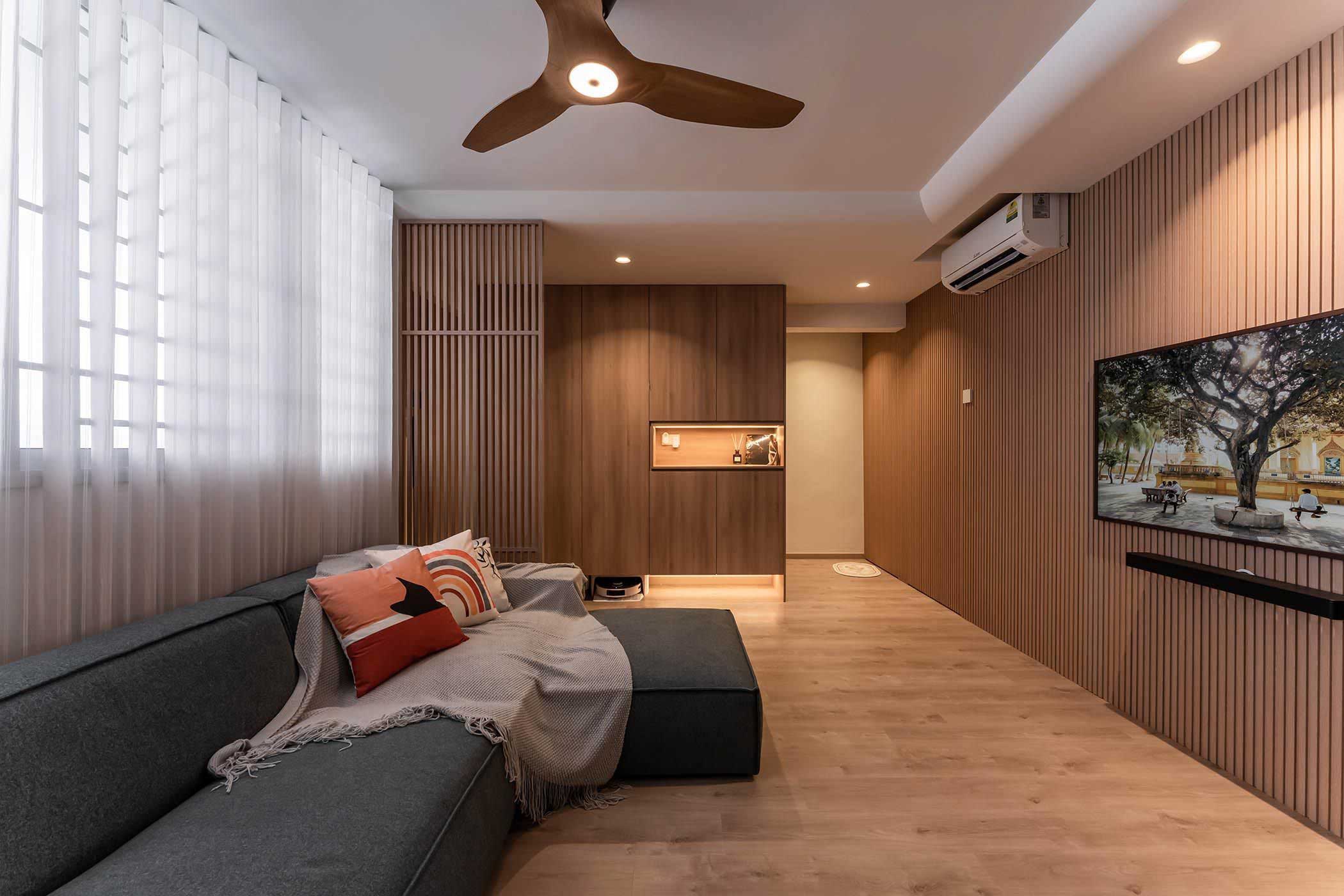
Image Credits: Quad R Design
4. Fluted Carpentry: Texture Comes With Grooves
Fluting may feel like a modern interior trend, but the design language goes back thousands of years. Vertical grooves featured prominently on classical Greek columns, where they created rhythm, shadow and a visual impression of height.
In today's context, that same idea has been reinterpreted across cabinetry, kitchen islands and feature walls.
Why homeowners like it
Fluting can turn otherwise ordinary carpentry into a feature. The repeated vertical lines catch light throughout the day, creating depth and shadow without necessarily adding another colour to the room.
It can also visually emphasise height when used on taller cabinetry.
The reality
More texture also means more places for dirt to settle.
The grooves can trap:
-
Dust
-
Food particles
-
Airborne grease
-
Dirt around frequently touched surfaces
-
However, there is also the risk of overusing it.
If the kitchen island, TV console, shoe cabinet and wardrobes all use the same fluted treatment, what started as an accent can quickly become visually overwhelming.
What is it like to maintain?
Compared with flat laminate, cleaning requires more effort.
You may need to:
-
Run a cloth or duster along individual grooves
-
Use a soft brush for deeper recesses
-
Clean more frequently when fluting is near cooking areas
-
And placement makes a big difference.
A fluted TV console may only need dusting but a fluted cabinet next to a hob may collect dust and grease together.
Estimated Cost
Approximately S$25–S$70 per sq ft for decorative fluted panels, with customised cabinet fronts and detailed carpentry costing more.
Key Takeaways
Pros: Adds texture, depth and visual height.
Consider: More grooves for dust and grease to accumulate.
Best for: Homeowners who appreciate decorative details and do not mind slightly more cleaning.
Works well with: Japandi, contemporary, modern luxe, Scandinavian and warm minimalist interiors.
Recommended placement: Island fronts, feature walls, TV consoles and selected cabinet doors rather than directly beside high-grease cooking zones.
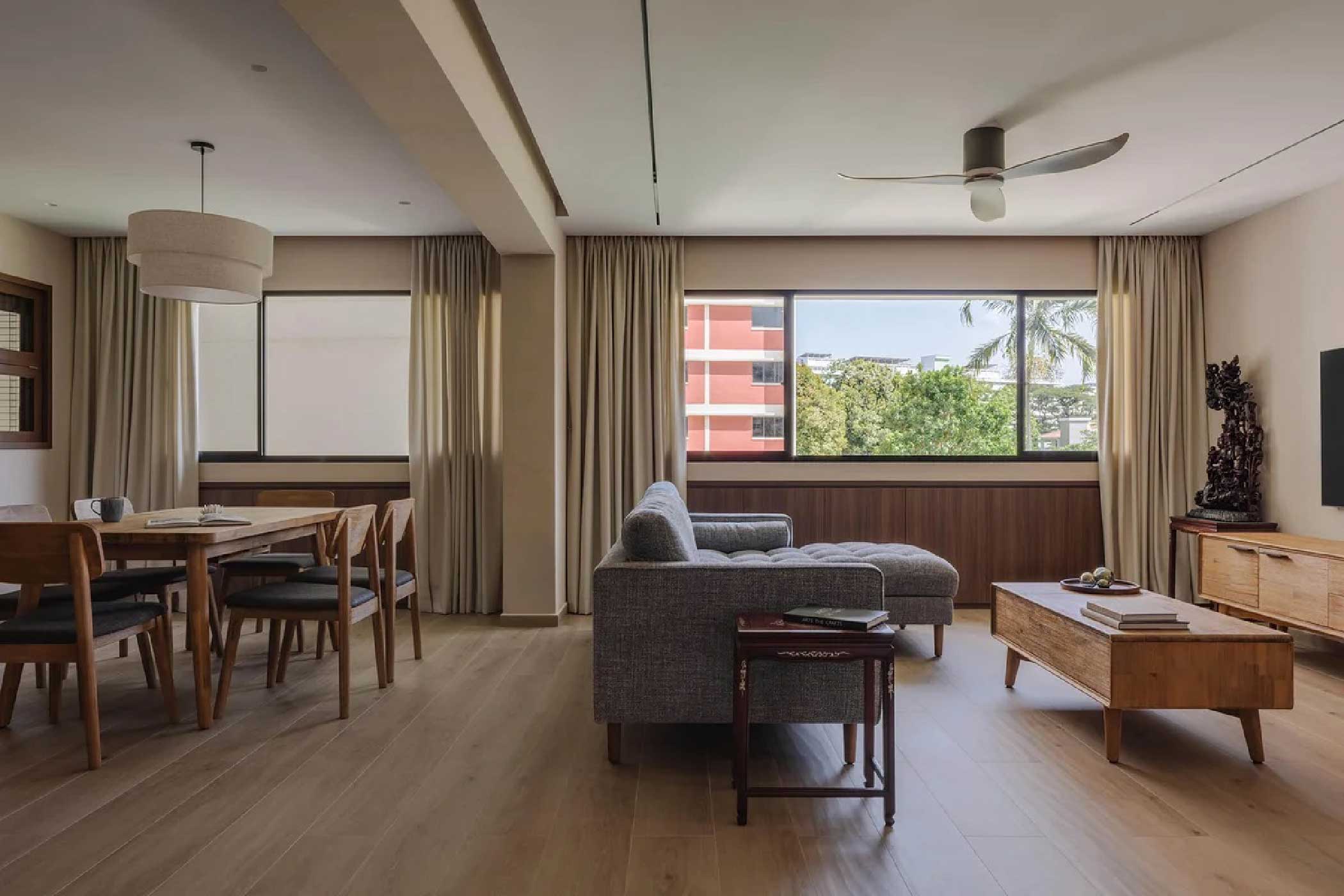
Image Credits: Lite Design Collaborative
5. Wood Veneer: Real Wood Comes With Real Care
Veneering techniques can be traced back thousands of years, including examples from ancient Egypt. Mechanised production later made veneer much easier to manufacture at scale.
Today, veneer allows carpentry to showcase genuine timber grain without constructing the entire cabinet from solid wood.
Why homeowners like it
Unlike printed wood-look laminate, natural veneer uses a genuine timber surface.
That means:
-
Natural grain variation
-
Less repetitive patterns
-
Warmer visual character
-
A richer, more tactile finish
Those slight irregularities are part of its appeal.
The reality
Veneer can be more sensitive to:
-
Moisture
-
Scratches
-
Direct sunlight
-
Prolonged water exposure
Placement therefore matters. A veneer TV console in a dry living room faces very different conditions from cabinetry positioned beside a kitchen sink. Homeowners should also remember that veneer is only the surface finish. The substrate and cabinet carcass underneath matter too.
What is it like to maintain?
Natural veneer generally benefits from gentler cleaning.
For upkeep:
-
Use a soft, slightly damp cloth
-
Wipe spills promptly
-
Avoid soaking the surface
-
Avoid harsh cleaners and abrasive sponges
-
Be mindful of prolonged direct sunlight
-
Timber may also gradually change colour with UV exposure.
The trade-off is simple:
You get the warmth and irregularity of real wood, but you need to treat it like real wood too when it comes to maintenance.
Estimated Cost
Veneer-finished custom carpentry can broadly cost around S$180–S$400 per foot run, depending on the built-in, veneer selection and detailing.
Key Takeaways
Pros: Genuine timber grain, natural variation and a more premium appearance.
Consider: Greater sensitivity to water, scratching and UV exposure than many synthetic finishes.
Best for: Homeowners who value natural materials and accept that they may age and change slightly over time.
Works well with: Mid-century modern, Japandi, contemporary, warm minimalist and modern luxe interiors.
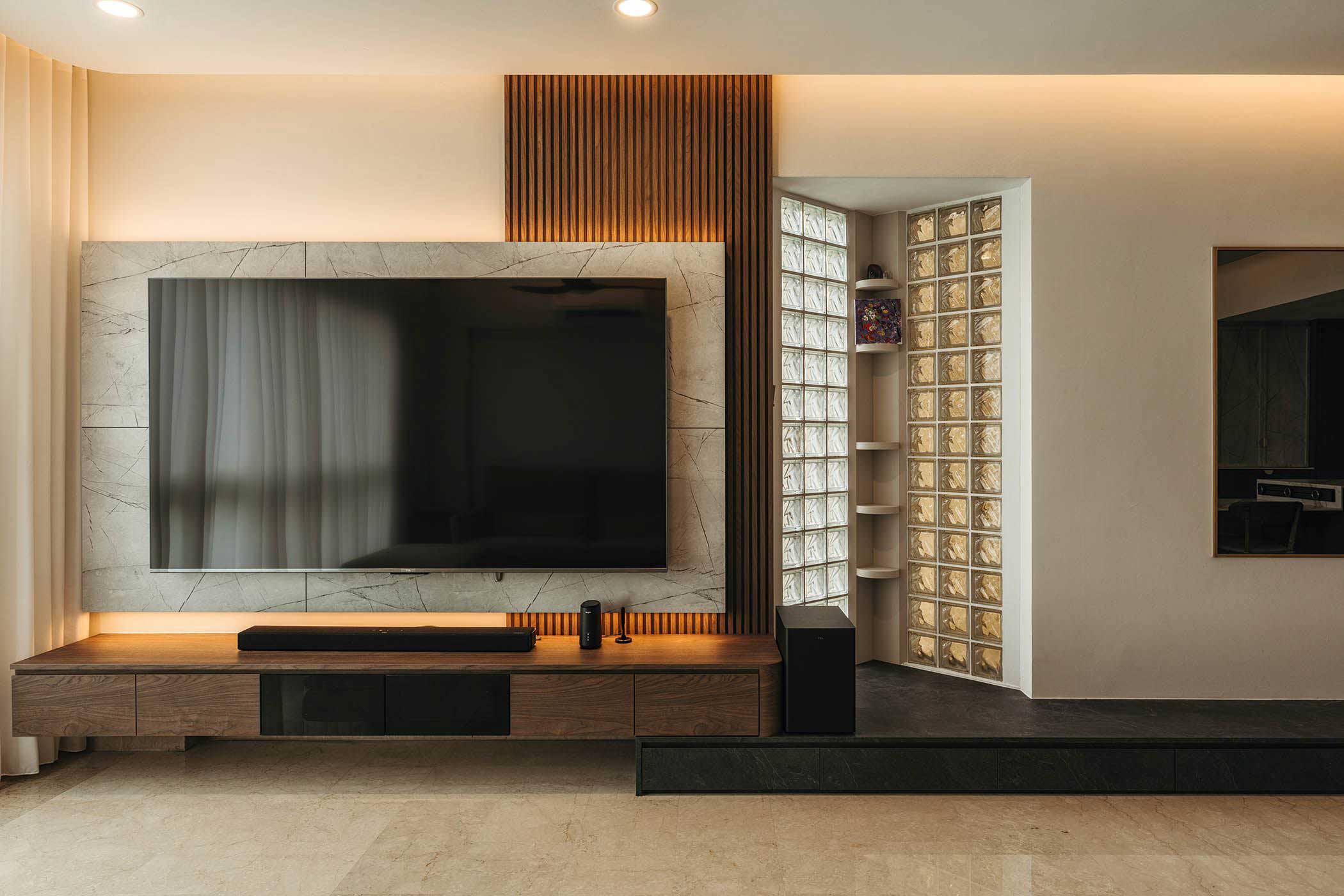
Image Credits: ProjectGuru
6. Glass Blocks: Retro Appeal, With Joints to Think About
Glass blocks are another example of an old architectural material becoming new again.
Swiss architect Gustave Falconnier patented an early hollow glass building block in the late 19th century. The material later became associated with Art Deco, mid-century architecture and, eventually, the unmistakable glass-block interiors of the 1980s and 1990s.
Today, designers are bringing them back to divide spaces without completely shutting out natural light.
Why homeowners like them
Glass blocks solve an interesting renovation problem:
How do you separate two spaces without completely blocking the light?
Unlike a conventional solid wall, translucent blocks allow daylight to pass through while obscuring direct views.
That can make them particularly useful in compact Singapore homes where adding another solid partition might leave one side of the home feeling dark and small.
The reality
A glass-block wall is not simply decoration. Once installed, it becomes part of the architecture of the home.
However, things to consider include:
-
Proper structural support
-
Installation detailing
-
Curved or customised layouts
-
HDB renovation requirements
-
The permanence of the feature
For HDB flats, proposed glass-block walls should comply with prevailing HDB renovation guidelines.
What is it like to maintain?
The glass itself is straightforward to clean. However, the bigger maintenance consideration is the joints.
Over time:
-
Dust can settle along the joints
-
Grout or mortar may discolour
-
Humid areas may require more regular cleaning
-
Large walls mean many more joints than a normal glass panel
So, cleaning a glass-block wall is not quite as simple as wiping down one large pane of glass.
Estimated Cost
Basic glass-block installations may start from around S$180–S$340 per sq m, while larger customised feature walls can easily run into the thousands.
Key Takeaways
Pros: Allows daylight through, improves visual privacy and creates a strong architectural feature.
Consider: Numerous joints, installation complexity and a relatively permanent design commitment.
Best for: Homeowners who want spatial separation without completely sacrificing natural light.
Works well with: Mid-century modern, retro, industrial, contemporary and eclectic interiors.
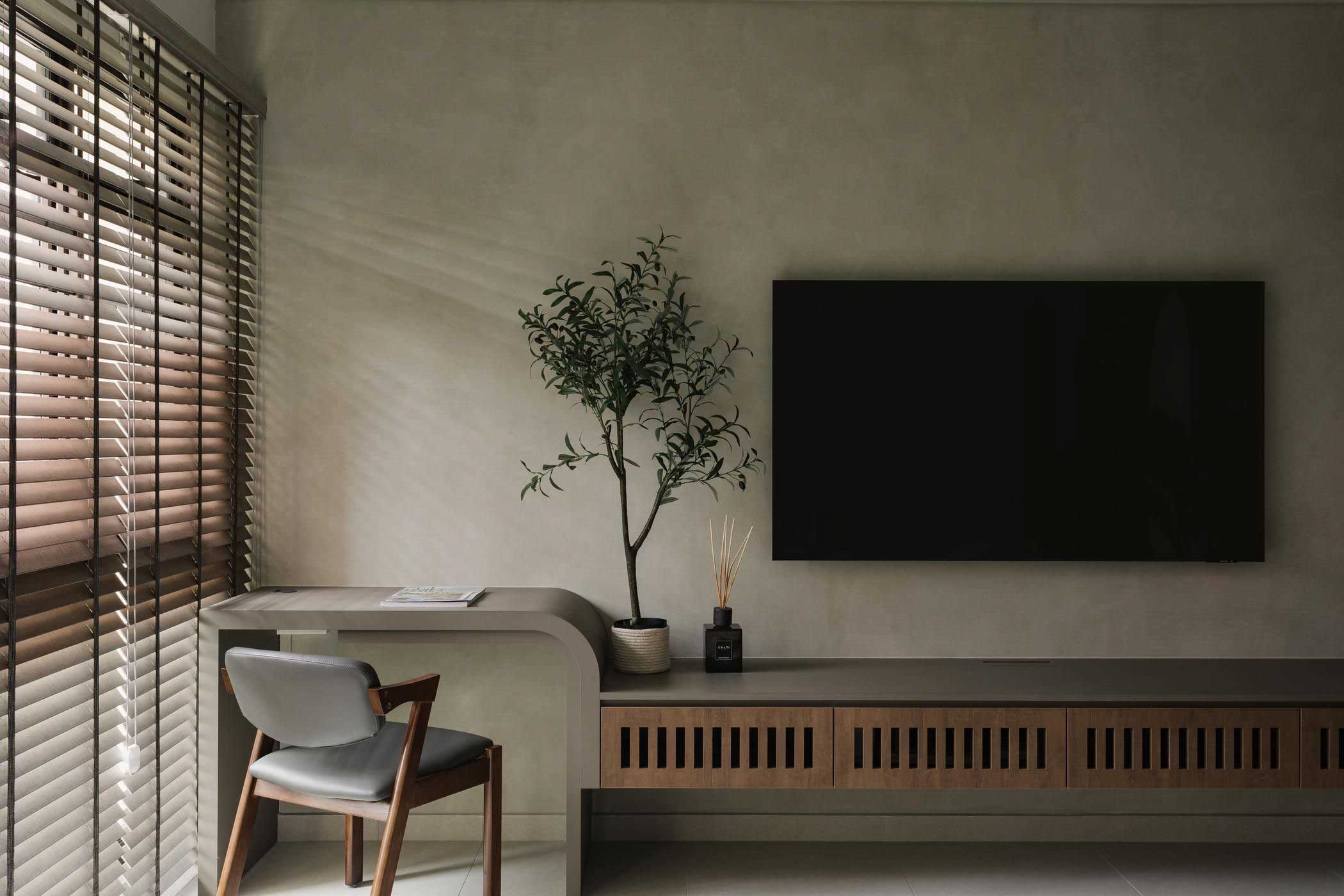
Image Credits: Cheng Yi Design
So, Which Material Should You Choose?
There is no renovation material that gives you everything.
Each comes with trade-offs between:
-
Appearance
-
Durability
-
Maintenance
-
Cost
-
Workmanship
-
How the material ages
So instead of asking:
“What material is the best?”
Ask:
“What material works best for the way I actually live — and what am I willing to pay and maintain for it?”
Before confirming any material:
-
Ask to see a physical sample
-
Touch and feel the finish
-
View it under different lighting
-
Ask how it should be cleaned
-
Check whether it needs sealing or future maintenance
-
Ask what happens if it chips, scratches or gets wet
-
Compare quotations based on the same specifications rather than simply choosing the lowest price
Because choosing renovation materials is not only about how your home looks on handover day. It is about what you are willing to live with long after.
Frequently Asked Questions
What are some popular renovation materials in Singapore right now?
Metallic surfaces, sintered stone, microcement-style finishes, fluted carpentry, natural wood veneer and glass blocks are among the materials increasingly appearing in contemporary Singapore interiors. Their suitability, however, depends on where they are used and how much maintenance the homeowner is comfortable with.
Does microcement require maintenance?
Yes. Maintenance depends on the exact microcement or decorative cementitious system used, including its protective finish. Homeowners should follow the manufacturer's recommended cleaning method and ask their contractor or interior designer whether the system requires any future surface maintenance.
Is wood veneer suitable for kitchen carpentry?
It can be used in kitchens, but natural veneer is generally more sensitive to prolonged moisture than many synthetic laminates. Homeowners should pay particular attention to where it is used, the substrate beneath it and how edges are detailed around wet areas.
Are glass blocks suitable for HDB flats?
Glass-block walls can be used in HDB flats subject to HDB's prevailing renovation guidelines and technical requirements. Homeowners should check the latest requirements and have their designer or contractor confirm that the proposed installation complies before work begins.
How much should I budget for renovation materials in Singapore?
As a rough guide:
-
Stainless-steel countertop: S$250–S$400 per linear foot
-
Sintered stone: S$120–S$220 per foot run
-
Microcement: S$16–S$23 per sq ft
-
Fluted panels: S$25–S$70 per sq ft
-
Veneer carpentry: S$180–S$400 per foot run
-
Glass blocks: From around S$180–S$340 per sq m
These are planning estimates rather than fixed quotations. Final costs depend on material specifications, fabrication, labour and installation complexity.


